Finally Made it to Manta Arch and Shark Gutter at South solitary over the weekend to check out all the endangered Grey Nurse Sharks! The season to see these amazing creatures is just beginning to pick up as the water cools down. We saw around 10 nurses on our dive (approximately 25 to 28 m depth) but as winter progresses is not rare to see about 20 together at one time. Grey Nurse Sharks are critically endangered and were the first protected shark species in the world. They grow to about 3.5 meters in length and were nearly hunted to extinction as they were thought to be ferocious and responsible for human attacks due to their size and appearance (they are actually not aggressive sharks). Even though deliberate killing has been banned they still face many threats including shark netting on beaches, commercial fishing trawling, bottom set fishing lines and finning (cutting off of shark's fins for human consumption, illegal in most areas now but still prevalent). Additionally, they do not reach sexual maturity until they are 6 to 8 years old giving birth every other year to 1 or 2 young, this slow maturity increases their susceptibility to population decline. Marine sanctuaries, such as that in the Solitary Islands, aid in protecting breeding and feeding grounds, ban fishing and collecting and impose conduct regulations for diving with Grey Nurses. However, without accurate population estimates (estimates range anywhere from 300 to 1300 individuals) or widespread management plans to assist in their recovery they are still greatly at risk for extinction.
http://www.facebook.com/photo.php?v=240250632742748
here is a quick video from Jetty Dive of a few of the sharks at the beginning of our dive!
An article about a Grey Nurse Found decapitated on the beach recently
http://www.dailytelegraph.com.au/news/sydney-news/anglers-blamed-after-decapitated-grey-nurse-shark-found-on-beach-at-terrigal/story-e6freuzi-1226357385601
Sunday, 20 May 2012

Wednesday, 16 May 2012
Reflecting on Goals... Part 1
When submitting a proposal to OSU to have a work site/ program approved for internship credits a large part of the process included developing professional, personal and cross cultural goals for the time abroad. As I was answering a series of check in questions for my advisor I couldn’t help but to reflect on a funny experience I encountered with one of my personal/ cross cultural goals. One of my goals was to learn to use the public transportation systems of Australia to be able to get around and between the cities and actually know where I was going. It sounds like a simple thing to learn but the extent of my bus riding prior to coming to Australia was taking the school bus my freshman year of high school and the last (and only) train ride I had been on was probably the scenic tour ride of the Gorge. My first experience on the train was just from Coffs Harbour to Sydney Central and then switching trains at Sydney Central to hop on the one that runs to the airport. All went well and I figured out what trains went where from what platforms and how to get around the city. All in all, Sydney Central was not nearly as bustling and crazy of a place as I had thought it would be. Feeling good about having taken on Sydney, I figured Brisbane and Cairns would be no problem. This time I even took a few busses to get around and made it there just fine, but it was on the way back that I must have gotten a little too cocky about my new found skills. I was taking the train in Brisbane from my hostel to the airport to return to Coffs. It was clearly morning commute time for all the business professionals of Brisbane dressed in their suits, meanwhile I had just hopped off the live aboard dive boat, ran out of any form of clean clothes days before, and just had my back pack with some dive gear and dirty clothes at this point. The train I wanted to catch was just about to leave as I got up to the platform and even though I knew there was another train going exactly where I needed to go 4 minutes later I thought I’d dash on and give it a try. I made it on but the doors closed on my backpack I was wearing and thus I was stuck in the door because I could not wiggle out of my back pack. I flailed around like a turtle on my back for awhile trying to push the giant red “door open” button that was just out of my reach meanwhile everybody just stood and watched until I finally asked someone if they could push the button for me. When they begrudgingly did the door finally opened and I was unstuck from it and flung forward. Needless to say it was definitely an embarrassing train ride but at least now I know what all of the posters around the train station mean when they say “it is safer to wait for the next train”.


Thursday, 10 May 2012
More on Mollusks
Mollusk collection has finally begun in full force. Beyond general surveying to examine mollusk range as an indicator species for greater issues such as sea level rise, biodiversity loss in increased temperatures, sensitivity to pH levels etc... we will be extracting DNA samples for genetic analysis for the Barcode of Life Initiative. Obtaining this genetic data will define species boundaries which can be difficult due to solely based on morphology due to phenotypical variation. Thus a baseline catalogue of of species will become accessible which is essential to identify what exactly it is we are trying to conserve. All data is gathered into the worldwide BOLD database which offers morphological and geographical data on the species in addition to the barcodes. As the database grows I think it will be interesting to examine the ecophenotypes and genetic variability by region offering insight into their evolution and species delimitation. As a strong database continues to develop it will have many additional uses such as determining the diets and trophic levels of organisms by doing gut samples and obtaining DNA from the prey in the stomach and intestines and thus identifying exactly what it has eaten by matching barcodes from gut contents to barcodes in the database. This would me much more accurate and easier than current gut analysis techniques as the food that is too digested to be identified normally could still be identified by obtaining DNA that would still be extractable. Another increasingly common application of DNA barcode information is using it to crackdown on seafood fraud which has become more prevalent in recent years. Currently the FDA is utilising this information and it is likely that other agencies will begin to as well given the success the FDA is having. As the database becomes more complete (it encompasses all species not just mollusks, mollusks are just the category that is most in need of genetic analysis currently) it will become more widely utilised for a range of research and practical applications.
Within the next month we are hoping to collect 200 species of mollusks with 2 specimens of each species. Last Wednesday's collection yielded approximately our first 30 species from rocky shore habitats at Mulloway Beach and Thursday was a day of diving to survey South and Split Solitary Island's mollusks and collect on the third dive at Muttonbird Island. Unfortunately currents were strong and visibility dropped from about 12 meters at Split and South to 1 meter at Muttonbird so we were only able to collect about 10 species. This week we did a rocky shore collection from Woolgoolga and I was fortunate to have the help of a few of Steve's (the head mollusk researcher at the NMSC) third year marine science students to turn some boulders and search for mollusks. We found another 20 or so species we had not yet collected but I was worried we might lose a couple when the guys thought it would be funny to put an octopus in my bucket of samples, needless to say octopus love eating mollusks. It all worked out in the end despite an angry octopus spraying me with water and causing a scene while trying to get it out of the bucket before it ate any samples. After the slight ordeal, I still have plenty of mollusks from the last 2 weeks to keep me busy for awhile. Collecting will prove to be the easy part; After getting some photos for each specimen they go into 95% ethanol until I will have time to dissect them in the lab. I have to obtain a tissue sample without contaminating it with any contents from the stomach or intestines in order to get a clean DNA sample. For bivalves it is supposed to be ideal to sample from the adductor muscle and for gastropods just behind the operculum but the smaller the mollusk the harder it becomes. I have a feeling by it is going to take all 400 samples to master the best technique!
I will try and get some mollusk photos up soon!
Monday, 30 April 2012
Diving the Great Barrier Reef and Osprey Reef


 |
| Safety Stop Tank |


 |
| Potato Cod (my new favorite fish) |

 |
| Disco Clam (reflects light back with its scilia if you shine a torch at it) |
 |
| Stonefish |

 |
| Shark! (Night Dive) |
 |
| Pink Lacy Scorpionfish |
 |
| The reefs where full of gray whaler, white tip, black tip and silver tip reef sharks and even spotted a hammerhead! |
 |
| Chevron Barracuda |

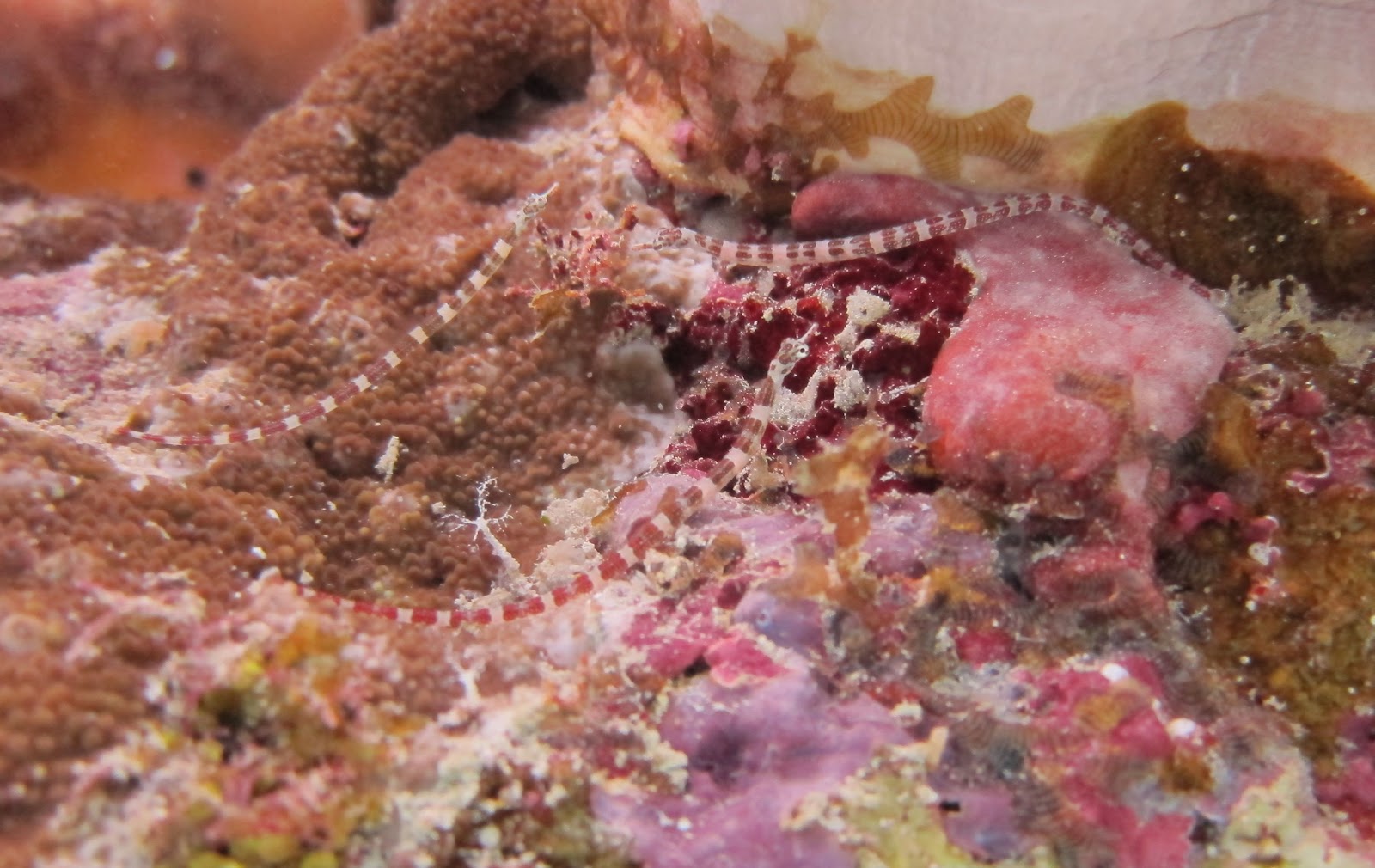 |
| Pipefish |


Sunday, 22 April 2012
Exploring New Zealand
While working at the center I accrue vacation time and have a lot of flexibility in my work schedule which gives me the opportunity to go travelling and exploring beyond just the weekends. Ideally I would have loved to be able to take a month a then end of my time at the center just to travel around and explore however it was just not possible to do so with my time frame in which I need to return to work at home with the Forest Service. Having the flexibility to incorporate travel throughout my time here is a definite perk of the casual work environment at the center. Recently I used some of my vacation time to travel to the South Island of New Zealand with my mom while she was in town. It was an incredibly worthwhile trip as it is a short and affordable flight from Sydney yet entirely different terrain and landscape. We flew into Christchurch and picked up a rental car there to begin our road trip. Christchurch is a relatively popular city to explore however a massive earthquake hit Christchurch last year destroying a lot of the historic buildings thus there is a lot of construction going on currently to rebuild. After a short trip into the city we opted to continue south and stopped at a fruit and veggie stand on the outskirts of town to stock up for the week. Our next stop was Queenstown. The drive there was beautiful through a lot of farm land and upon our arrival in Queenstown we took a very scenic gondola ride and explored Arrowtown, a historic gold mining town, and stopped at one of the many wineries of the area. From Queenstown we headed to Te Anu for a horseback ride and to check out the wildlife refuge, beautiful lake and lakeside tracks and glow-worm caves which we took a night tour of. Our next stop was Milford Sound, not actually a Sound but a stunning miss named fiord. From Milford Sound we headed to Mt Cook National Park which offered plenty of hiking and we took a boat ride out to the Tasman Glacier which is the largest glacier in New Zealand. From Mt. Cook we headed back to Christchurch for our return flight to Sydney and then road tripped up the coast from Sydney to Byron bay before heading back to my house in Coffs Harbour. It was an action packed couple of weeks but an absolutely amazing experience and I would recommend that any one travelling to Australia also makes time for a pit stop in New Zealand as well.
 |
| Fruit and Veg Stand |
 |
| Woodend Beach just Outside Christchurch |
 |
| The giant Salmon we encountered on our road trip |
 |
| Amisfield Winery |
 |
| Red Deer farmed everywhere |
 |
| Lake Te Anu |
 |
| Our trusty steeds: Kepler and T.J. |


 |
| Cruising Milford Sound |

 |
| Milford Sound |


 |
| Tasman Glacier |
Subscribe to:
Posts (Atom)