Mollusk collection has finally begun in full force. Beyond general surveying to examine mollusk range as an indicator species for greater issues such as sea level rise, biodiversity loss in increased temperatures, sensitivity to pH levels etc... we will be extracting DNA samples for genetic analysis for the Barcode of Life Initiative. Obtaining this genetic data will define species boundaries which can be difficult due to solely based on morphology due to phenotypical variation. Thus a baseline catalogue of of species will become accessible which is essential to identify what exactly it is we are trying to conserve. All data is gathered into the worldwide BOLD database which offers morphological and geographical data on the species in addition to the barcodes. As the database grows I think it will be interesting to examine the ecophenotypes and genetic variability by region offering insight into their evolution and species delimitation. As a strong database continues to develop it will have many additional uses such as determining the diets and trophic levels of organisms by doing gut samples and obtaining DNA from the prey in the stomach and intestines and thus identifying exactly what it has eaten by matching barcodes from gut contents to barcodes in the database. This would me much more accurate and easier than current gut analysis techniques as the food that is too digested to be identified normally could still be identified by obtaining DNA that would still be extractable. Another increasingly common application of DNA barcode information is using it to crackdown on seafood fraud which has become more prevalent in recent years. Currently the FDA is utilising this information and it is likely that other agencies will begin to as well given the success the FDA is having. As the database becomes more complete (it encompasses all species not just mollusks, mollusks are just the category that is most in need of genetic analysis currently) it will become more widely utilised for a range of research and practical applications.
Within the next month we are hoping to collect 200 species of mollusks with 2 specimens of each species. Last Wednesday's collection yielded approximately our first 30 species from rocky shore habitats at Mulloway Beach and Thursday was a day of diving to survey South and Split Solitary Island's mollusks and collect on the third dive at Muttonbird Island. Unfortunately currents were strong and visibility dropped from about 12 meters at Split and South to 1 meter at Muttonbird so we were only able to collect about 10 species. This week we did a rocky shore collection from Woolgoolga and I was fortunate to have the help of a few of Steve's (the head mollusk researcher at the NMSC) third year marine science students to turn some boulders and search for mollusks. We found another 20 or so species we had not yet collected but I was worried we might lose a couple when the guys thought it would be funny to put an octopus in my bucket of samples, needless to say octopus love eating mollusks. It all worked out in the end despite an angry octopus spraying me with water and causing a scene while trying to get it out of the bucket before it ate any samples. After the slight ordeal, I still have plenty of mollusks from the last 2 weeks to keep me busy for awhile. Collecting will prove to be the easy part; After getting some photos for each specimen they go into 95% ethanol until I will have time to dissect them in the lab. I have to obtain a tissue sample without contaminating it with any contents from the stomach or intestines in order to get a clean DNA sample. For bivalves it is supposed to be ideal to sample from the adductor muscle and for gastropods just behind the operculum but the smaller the mollusk the harder it becomes. I have a feeling by it is going to take all 400 samples to master the best technique!
I will try and get some mollusk photos up soon!
Thursday, 10 May 2012

Monday, 30 April 2012
Diving the Great Barrier Reef and Osprey Reef


 |
| Safety Stop Tank |


 |
| Potato Cod (my new favorite fish) |

 |
| Disco Clam (reflects light back with its scilia if you shine a torch at it) |
 |
| Stonefish |

 |
| Shark! (Night Dive) |
 |
| Pink Lacy Scorpionfish |
 |
| The reefs where full of gray whaler, white tip, black tip and silver tip reef sharks and even spotted a hammerhead! |
 |
| Chevron Barracuda |

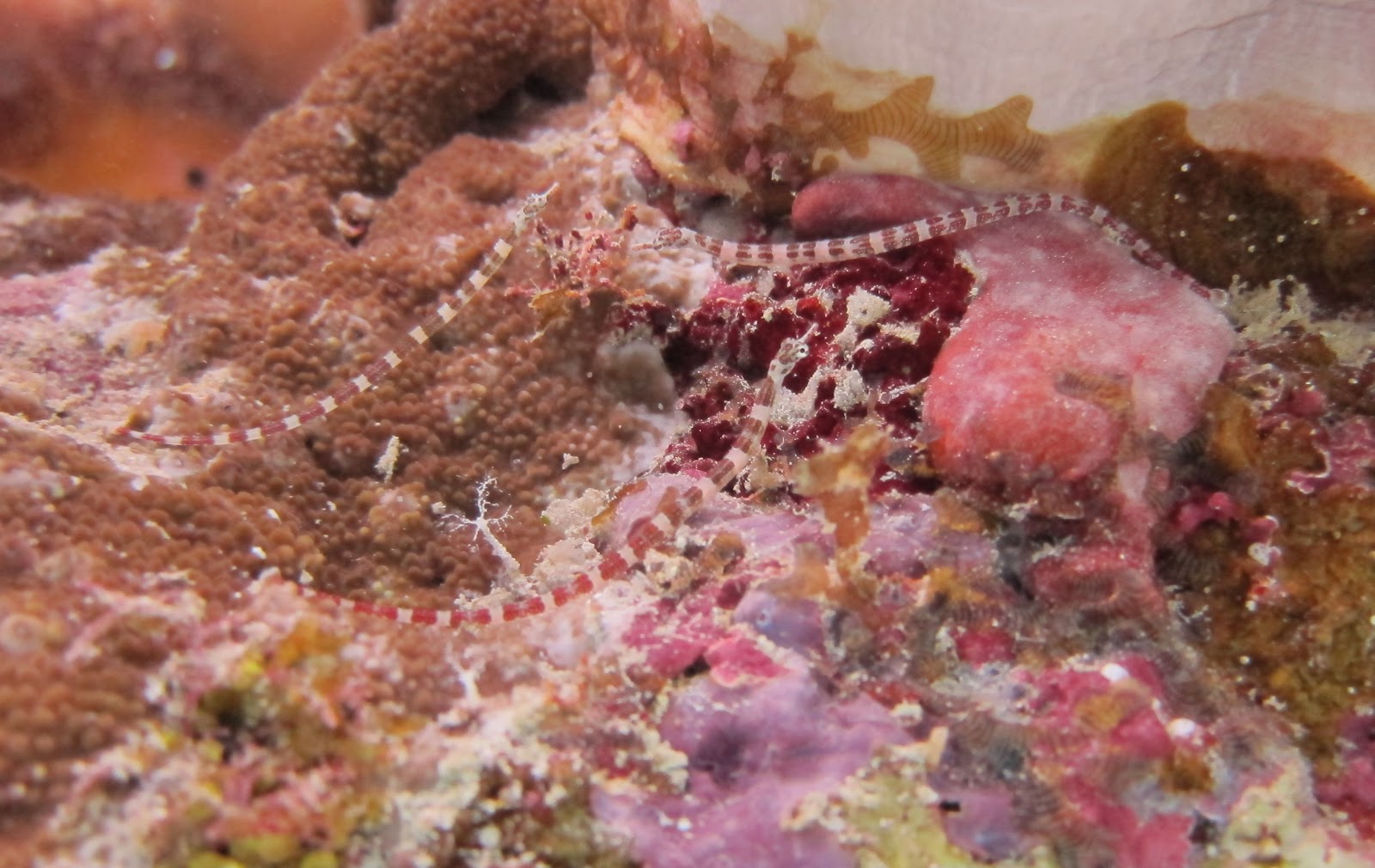 |
| Pipefish |


Sunday, 22 April 2012
Exploring New Zealand
While working at the center I accrue vacation time and have a lot of flexibility in my work schedule which gives me the opportunity to go travelling and exploring beyond just the weekends. Ideally I would have loved to be able to take a month a then end of my time at the center just to travel around and explore however it was just not possible to do so with my time frame in which I need to return to work at home with the Forest Service. Having the flexibility to incorporate travel throughout my time here is a definite perk of the casual work environment at the center. Recently I used some of my vacation time to travel to the South Island of New Zealand with my mom while she was in town. It was an incredibly worthwhile trip as it is a short and affordable flight from Sydney yet entirely different terrain and landscape. We flew into Christchurch and picked up a rental car there to begin our road trip. Christchurch is a relatively popular city to explore however a massive earthquake hit Christchurch last year destroying a lot of the historic buildings thus there is a lot of construction going on currently to rebuild. After a short trip into the city we opted to continue south and stopped at a fruit and veggie stand on the outskirts of town to stock up for the week. Our next stop was Queenstown. The drive there was beautiful through a lot of farm land and upon our arrival in Queenstown we took a very scenic gondola ride and explored Arrowtown, a historic gold mining town, and stopped at one of the many wineries of the area. From Queenstown we headed to Te Anu for a horseback ride and to check out the wildlife refuge, beautiful lake and lakeside tracks and glow-worm caves which we took a night tour of. Our next stop was Milford Sound, not actually a Sound but a stunning miss named fiord. From Milford Sound we headed to Mt Cook National Park which offered plenty of hiking and we took a boat ride out to the Tasman Glacier which is the largest glacier in New Zealand. From Mt. Cook we headed back to Christchurch for our return flight to Sydney and then road tripped up the coast from Sydney to Byron bay before heading back to my house in Coffs Harbour. It was an action packed couple of weeks but an absolutely amazing experience and I would recommend that any one travelling to Australia also makes time for a pit stop in New Zealand as well.
 |
| Fruit and Veg Stand |
 |
| Woodend Beach just Outside Christchurch |
 |
| The giant Salmon we encountered on our road trip |
 |
| Amisfield Winery |
 |
| Red Deer farmed everywhere |
 |
| Lake Te Anu |
 |
| Our trusty steeds: Kepler and T.J. |


 |
| Cruising Milford Sound |

 |
| Milford Sound |


 |
| Tasman Glacier |
Saturday, 14 April 2012
Don't Let Go of the Long Line
New South Wales Fisheries is a cooperating organization with the National Marine Science Center. At home the equivalent organization in the sense of research and management roles would be the Oregon Department of Fish and Wildlife. To gain further experience and expand my knowledge on the fisheries management in Australia, NSW Fisheries has allowed me to assist in their research. The project that I have been working on is a four year research project to reduce bytcatch in commercial fisheries. Bycatch refers to any part of the fishers catch that is not the target species. Current bycatch advancements thus far is largely the modification of the use of square mesh panels in codends. This utilizes the behavioural differences between prawns and fish to lessen the bycatch. As the fish are herded together they try to escape by heading towards the top and sides of the codend and can escape through the open square-shaped meshes. By contrast, prawns have a limited reaction to the trawl and tumble along the bottom of the net into the codend. The size of square-mesh used in the panel directly determines the size of fish that are allowed to escape. Studies in the oceanic prawn trawl fishery have shown that codends with relatively small panels of square-mesh were effective in removing up to 40% of the total unwanted bycatch (NSW Fisheries). This sucess of the research thus far has led to further research on net placement and technique which is the current project I have the oppotunity to work on. NSW Fisheries cooperates with the local commercial fishermen, who allow us to attach devices to their nets that show the exact placement, depth, opening and movement of the nets and fuel usage while testing various net placements and set ups. For each trawl we pull in the nets and sort the bycatch from the prawns being careful not to touch any of the poisonous fish, weigh the total bycatch and prawn weight, and take a sub sample in which we record size and species. Common bycatch found includes Mulloway, Bream, Ramseys perchlet, Sole, Flathead, Cat fish and Bullrout. The ultimate goal is to create a net design and placement combination that will further reduce bycatch and use less fuel without reducing yield (or reducing yield no more than the money they would be saving in lowering fuel expenses) thus an alternative that fishermen will actually implement because it does not detriment their profit will be created.
Wednesday, 4 April 2012
Diving the Solitary Islands
Through the certification process, work at the Marine Center and volunteering I have found many opportunities for Scuba Diving in the Solitary Islands. My diving opportunities range from going on collections for the aquarium, participating in SURG fish and coral surveys, recreational diving and we are about to begin a large scale mollusk collection for genetic analysis at the center which will include both collecting the organisms (for later genetic analysis) as well as photographing each individual. Prior to arriving in Australia I was not certified and had no experience diving. Although obtaining my certification was not required for work it was encouraged and definitely something that I wanted to give a try. The PADI (Professional Association of Dive Instructors) open water diver certification process was really straight forward, as I did the theory portion online prior to the practical portion which I completed at Jetty Dive in Coffs Harbour. The practical portion includes a swim test, a day of pool skills and then 4 dives of applying the skills in the open water. After completing my open water certification I decided to continue on to my advanced certification (which I am currently working on) which consists of more theory and skills including deep diving, underwater navigation, night diving and a range of optional skills. The Solitary Islands has proved to be an amazing place to learn to dive and constantly continue to improve upon my skills.
 |
| Open Water Certification Crew |

 |
| The Solitary Islands are such phenomenal places to dive in terms of the amount of biodiversity seen because the warm tropical waters are brought down by the EAC (Eastern Australian Current) and mix with the cooler temperate waters so species from both tropical and cooler waters are present! |
 |
| "Scooter" one of the resident rays |

 |
| Wobbegong Shark |
The PADI website for information about becoming certified anywhere!
http://www.padi.com/scuba/default.aspx
Thursday, 15 March 2012
An overview of the first half of the internship
With my internship nearing the halfway point and the Oregon State school term wrapping up it seems like a good time to reflect upon my internship thus far and offer some considerations for other students interested in similar internships for OSU credit or any working abroad experience at a research facility.
An average day at work: There is always a lot of variety in what I do on a daily basis at the Center but I have settled into a good work routine at this point. I usually work a Monday through Friday 9 to 5 schedule with the occasional early morning or late night if we have lots to do or are headed out for a lengthy field day. Upon arrival in the morning I spend the first few hours of every day tending to the aquaculture stocks, artemia and rotifer hatches and stocks and the aquarium fish. I feed them and maintain the tanks which require testing the water quality, cleaning protein skimmers, water changes and whatever else comes up. Following that I test and record the pH, temperatures and alkalinity of any experiments in the flow through lab and adjust them if need be. Once my routine tasks for the day are accomplished I work on whatever research project I am working on at the time, this includes any variety of tasks including setting up experiments, collecting data from the experiments, field visits, collecting organisms, analyzing the data and composing scientific reports or going on fisheries trawls for bycatch surveys and research. During lunch break (when we aren’t in the field) often times people will spend it swimming, surfing or just hanging out at the beach. If I find that I have free time throughout the day I use that to work on developing an outreach program or reviewing existing publications on the research topics I am working on. With so much to do there is never a slow day at work!
Transportation: My main form of transportation is my bicycle. I live in the “down town” area of Coffs Harbour so I am conveniently close to grocery stores, shops and whatever else I could need. The Center is located a little ways north of the downtown area however so it is possible but not realistic to walk to work. Co-workers are always more than willing to give me a lift if I need but I usually prefer to ride my bicycle anyway so I am on my own schedule and not depending on any one else to get around. I usually bike ride the scenic way so it is about a 20 minute bike ride to work but there are some killer hills and it rains a lot but luckily there is a shower at work! I see my bike ride as a great way to start and end the work day with some exercise and a pretty ride however Coffs Harbour is not an easy town to get around in due to the hills, weather and the unreliable and limited public transportation system so a bicycle is really the best option for anyone who is at least moderately fit, not afraid of the rain and does not want to purchase a car.
Living Situation: I rent a room in a 4 bedroom town house. Finding a place was an enormous challenge but I was fortunate to have Georgia (my main contact at the center before I started) to help me with what seemed like the endless search for a place to live. I ended up staying at the hostel longer than I anticipated while I looked for a good place but it was worth the wait! I have realized that the living situation can really influence the experience you have and I am fortunate to live with young friendly roommates that like to explore!
Saturday, 3 March 2012
EIS for Recreational Fish Stocking
Below is the link for the environmental impact statement for the purposed marine fish stocking in New South Wales. Not a light read, but its very interesting to contrast the management plans for stocking for recreational fishing in Australia versus the US. The biggest challenge in starting up the stocking program is finding an appropriate brood stock with adequate genetic variation as the majority of brood stocks will only consist of 5 females of each species.
http://www.dpi.nsw.gov.au/__data/assets/pdf_file/0009/415764/Marine-Fish-Stocking-Vol-III-Online-Version.pdf
http://www.dpi.nsw.gov.au/__data/assets/pdf_file/0009/415764/Marine-Fish-Stocking-Vol-III-Online-Version.pdf
Subscribe to:
Posts (Atom)